Showing posts with label City budget. Show all posts

Thursday, May 19, 2011

Ann Arbor Employee Car Allowances

In our effort to help the city identify some areas where cost reduction could occur without cutting citizens services I asked my Council member if he could supply a list of the city employees that receive a monthly car allowance. The following table is the information that we received.

Detail Earnings by Employee
City of Ann Arbor Master Company
Select: Company is CAA - City of Ann Arbor and Earnings Code is CAR
Sort Order: Service Area(Asc), Service Unit(Asc)
Pay Period Range: 201104010 - 201104309
SERVICE AREASERVICE UNITEMPLOYEEMONTHLY AMOUNT
City AttorneyCity AttorneyPostema, Stephen K.$330.00
City AdministratorCity AdministratorFraser, Roger W.$400.00
Community Services&nbspParks & RecreationStraw, Jeffrey D.$200.00
Community Services Parks & RecreationSmith, Colin$200.00
Community ServicesPlanning & DevelopBahl, Sumedh$300.00
Community ServicesPlanning & DevelopWelton Jr., Ralph R.$150.00
DD AgenDDAPollay, Susan$315.63
Finance & AdminCity AssessorCourtney, Michael S.$180.00
Finance & AdminCity AssessorWeber, Annette M.$180.00
Finance & AdminCity AssessorForner, Patricia R.$180.00
Finance & AdminCity AssessorBalogh, Amy$180.00
Finance & AdminCity AssessorPetrak, David R.$180.00
Finance & AdminCity AssessorDoletzky, Ryan E.$180.00
Finance & AdminFinance AdministrationCrawford, Thomas E.$350.00
Public ServicesField OperationsKonwinski, Julian M.$ 50.00
Public ServicesFleet ServicesCrum, Dennis L.$300.00
Public ServicesPublic Services AdminKulhanek, Matthew J.$300.00
Public ServicesPublic Services AdminCariano, Robert L.$300.00
Public ServicesPublic Services AdminMcCormick, Susan F.$300.00
Public ServicesSystem PlanningHupy, Craig$300.00
Public ServicesWastewater Treatment Kenzie, Earl J.$300.00
Safety ServicesFireDziubinski, Edwin J.$375.00
Safety ServicesFireHubbard, Ollice$375.00
Safety ServicesPoliceSeto, John Y.$375.00
Safety ServicesPoliceBazick, Gregory D.$375.00
Safety ServicesPoliceJones, W B.$400.00
TOTAL


$7,075.63


Why are we giving so many employees such large car allowances? Why are we encouraging city employees to live outside the city by subsidizing their commuting costs? It seems that the city's policy of encouraging alternate transportation does not apply to the employees. Is it only the taxpayers that should walk or take the bus so that there would be less congestion for the city administrators?

The parking for city employees is also provided. That is one of the reason the downtown parking rates are so high. If some spaces do not contribute to the cost of the parking structure the remaining spaces must make up the difference.

Eliminating these two perks would save about enough to avoid one of the proposed police or fire fighter layoffs.

Karen Sidney

Saturday, May 14, 2011

KAREN'S* FY2012 BUDGET NEWSLETTER - Issue 1

THE FY 2012 BUDGET

The FY2012 budget is on the May 16, 2011 Council agenda. Under our city charter, the city administrator proposes a budget which goes into effect unless 7 council members vote to change it. The proposed budget continues the trend of cutting basic services, especially police and fire, which will see 10 layoffs plus elimination of vacant positions. Mayor Hieftje and his supporters on Council insist that Ann Arbor is better off than other cities and the cuts are unavoidable result of the recession.

The truth is that Ann Arbor is better off than other cities because we pay higher per capita taxes than other cities, even with all that U of M and city park land off the tax rolls. There are other solutions to the current fiscal mess the Mayor and his supporters have created besides continuing to slash basic services. Below are my suggested changes to the budget.


Eliminate pork projects

1. A $639,422 contingency is included in the general fund budget. This contingency is in the same line item that was used in the 2011 budget to cover the Justice Center overruns. If the city administrator can't explain what the money is for, it shouldn't be in the budget. The budget should be amended to eliminate this contingency and restore police and fire positions.

2. $2.2 million for more new garbage trucks is included in the fleet fund budget. The fleet fund is an internal service fund. According to the last audit the city has an all time high of 28 garbage trucks, up from 18 the year before. Most of the $2.2 million is for new residential collection trucks even though Sue McCormick says she plans to outsource residential collection. Apparently the garbage company that gets the residential collection monopoly also gets a big taxpayer subsidy in the form of new trucks. Residents get higher fees and fewer services. Cancel the new trucks and restore services to residents.

3. $1 million for new parks vehicles is also included in the fleet fund budget. Parks needs a lot of things but $1 million in new vehicles is not high on the list. Cancel the new vehicles and transfer the $1 million to the parks millage fund, overseen by the Parks Advisory Commission.


Eliminate overcharging for internal services

Internal service funds are supposed to be break even but the latest audit shows the city's internal service funds have built up a cash hoard of about $20 million. That means these funds have overcharged other city departments $20 million. Internal service funds are used to divert money that should be used for basic services to more ego projects. $3.3 million in overcharges by the insurance fund were used to help pay for the new Justice Center.

When the IT internal service fund was established in 2006, the charges for IT services doubled. In 2006, the charges for fleet services also doubled while City Hall touted efficiencies from the $35 million new maintenance facility. The Increased charges have allowed the city's top management to pursue more ego projects at the expense of basic services. Your street may not get plowed, but when the plow finally comes, it's state of the art.

Establish a new city policy to refund the overcharges.


More doers and fewer managers

In 2002, the city had 958 employees. The city administrator's 2013 budget proposes 688 employees, a 28% drop. But the pain from staff cuts has not been shared equally. By 2013 police and fire will have lost 35% of their staff compared to 2002 levels while the city attorney and district court have lost about 12% of their staff and the city administrator service area has lost 16%.

Winners include the DDA, whose staff has doubled, and public services area management. Sue McCormick oversees the Public Services area. Compared to 2002, the proposed 2013 budget has about 25% more people planning and overseeing capital projects, 33% more people in public services administration but 33% fewer people assigned to field operations, which is responsible for performing services like plowing, tree maintenance and road repair.

One example of the shift from doers to managers is forestry. Before the Roger Fraser reorganization, the city had a city forester who was responsible for taking care of our trees. When our last city forester, Paul Bairley, left, the city forester position was eliminated and replaced by an Urban Forester & Natural Resources manager (Kerry Gray) and a Field operations Supervisor III (Kay Sicheneder). The result has been big spending on a tree inventory and an urban forestry management plan while our trees continue to deteriorate.

Restore safety services positions and eliminate management positions.


Fewer Consultants

The city has become addicted to consultants. The city has even posted a RFP for a consultant to help the police chief decide who to promote. Recently, Sue McCormick told Council that there was no one on city staff capable of conducting a public meeting.

City staff needs to stop hiding behind consultants. We don't need to pay consultants to justify decisions that have already been made. We also don't need to pay consultants to conduct public meetings in order to manipulate us to make the “right” decision. City employees should be the ones talking to the public. The city staff member conducting the meeting should be the individual with decision making authority, not some junior staff member sent to absorb public anger about an unpopular decision.

Maybe if Roger Fraser, Mayor Hieftje and the council members who pushed the new justice center had had to face the public in a give and take public meeting, we might not have a new $50 million building next to city hall, which has been nominated for the dubious distinction of being the ugliest building in America.

Just say no to consultant contracts.

*Karen Sidney is an attorney and CPA. She has an expertise in forensic accounting, which is the art of finding out where the money is going when people can't or won't tell you.

Friday, April 29, 2011

Ann Arbor Park Funding

Background

The Ann Arbor Parks are funded from two sources. One is the city general fund which obtains money from the general city property taxes. The other is from special additional taxes that the citizens have agreed to pay, the Parks Millage.

In 2006 the Ann Arbor City Council proposed a new Parks Millage of 1.1 mills. This millage replaced two smaller millages that expired that year. The new tax was expected to generate slightly less than $5 million annually. This was approximately $1 million more than the millages it replaced. The increased tax was approved by the voters in November of 2006.

There was substantial popular concern that approving the additional millage would result in a shift in the Parks funding from the general fund to the millage rather than increasing the actual amount available for maintenance and improvement of the parks. To reduce this concern and encourage the voters to pass the increased tax, Council passed two resolutions, promising that if the 2006 park millage was approved the funding for parks from the general fund would increase or decrease by the same proportion as the general fund increased or decreased.

The first resolution passed in August 2006 stated that the funds for Police and Fire (Safety Services) were to be excluded from the calculation of the increase or decrease of the general fund.  This was amended in October to remove the exclusion of Safety Services from the calculation.

Both resolutions included a statement that the parks millage money would not pay municipal service fees. This was to avoid the transfer of fees from the millage to the general fund by  a "back door" service charge.

The purpose of this report is to test if the city is following Council's 2006 promise to the citizens.


Data

The data used in this analysis are from the cities and the city's proposed budgets. The data for the years 2007 through 2010 are from the audited financial reports . The data for the years 2011 and 2012 are from the proposed budgets.

GENERAL FUND

First let's look at the general fund


The red line is a linear regression line fitted to the data. This is a common method to predict trends and is often called a trend line. The trend is clearly flat.

The large increase in 2009 was the cost of the police early retirement. If the data from 2009 did not include the early retirement, the result would still be the same, or at most any trend would be very minor.

It should be noted that when Council member Taylor and others refer to the multimillion dollar “short fall” of the current budget this is not so much a short fall from past budgets as it is a short fall from the additional amount they wish to spend or have already spent.

PARKS

Now consider the contribution from the General Fund to the Parks.

Here is that chart


The additional taxes were first collected in FY 2008. The council resolution promised that Parks funding from the general found would not decrease if the voters approved the additional millage. Yet in every year since 2007 the funding has been reduced. The average decrease has been 14%. The trend is that decrease is increasing each subsequent year. The rate of decline is $290,000/year.

The parks appropriation have not followed the council resolution, as ammended in October 2008.

At the April meeting of the Parks Advisory Commission meeting Colin Smith stated that Parks staff relied on a document, “The Policies for Administration of the November 7, 2006 Charter Amendment” as their guide for following the Council resolution.

Council member Mike Anglin requested a copy of this document. The pdf file he received is here.

It is note worthy that the policy park staff believe they should follow is not the final amended resolution passes by Council. Their policy is based on the August resolution. Even so it is interesting to test if the park allocations agree with their policy statement.


SAFETY SERVICES

Lets look at the safety Service Funds next. Here is the chart of just the police and fire budget; that is the safety services.


The trend in the Safety Service fund dollars, including the budgeted 2011 and 2012 is flat. That is, there isn't any apparent increase or decrease. Again the bulge in 2009 is cause by the additional cost for the early retirement. Without this transfer the trend line would probably have a very slight positive slope.


GENERAL FUND minus SAFETY SERVICES

Since the trend of the general fund is flat, and the trend of the Safety Services is also flat we would expect the trend of the difference to also be flat. Here is a chart of those calculated data.


As expected, the trend line is flat. It is interesting to note that if the budgeted dollars for 2011 and 2012 are excluded, the slope of trend line for the years 2007 through 2010 is positive. The slope is nearly $1 million/year. The confidence in this value would be low because it is based on a small number of data points. Still it is strong indicator that Safety Services funding was cut more in that period than the remaining General Fund.

Again, here is the chart of the allocation of park funds from the general fund.


It is quite clear that the trend in the park allocation from the general fund does not follow either the Council resolution or the inaccurate Park Policy Statement.

MUNICIPAL SERVICE CHARGE

There is also another part of the story. As stated in the second paragraph, the Council resolution at the time the millage was proposed included a statement that the parks millage money would not be used to pay municipal service fees but could include IT and fleet service charges.

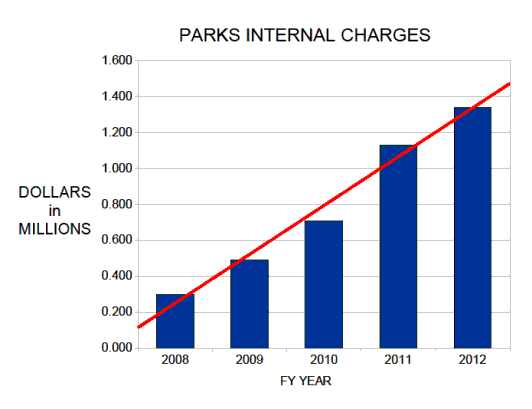
The city has not imposed a “municipal service charge” but it has greatly increased the allowable internal charges paid by the millage.  It is reasonable that the millage should pay some of these charges.  But is unreasonable that they should be increasing at such a rapid rate when services and personnel are decreasing. 


Initially in 2006 the charges were about $300,000; they are now budgeted to be over $1.3 million in FY 2012. The administration is doing exactly what Council attempted to prevent in the 2006 resolution. Internal service charges are being used to transfer money from the parks millage to the general fund. Obviously this reduces the millage resources that the citizens agreed to pay for parks improvement and maintenance.


Assertions by Others

The assertion that the city has not kept its promise made to the citizens  when the millage was proposed is not new. This allegation was made in 2007 by Council member Robert Johnson, Sierra Club Chairman; Doug Cowherd, and former Parks Advisory Commission chairperson Linda Berauer. Here is a link to the a video of the Council discussion.


Conclusions

The city has not kept it promise to the citizens that “if the 2006 park millage is approved by the voters the future funding for parks from the general fund would increase or decrease by the same proportion as the General Fund. It does not matter whether the total general fund is used in the calculation or the General fund excluding Safety Services.

The city has followed the words of the Council resolution prohibiting applying a muncipal service charge to the parks millage funds. It has not kept the spirit of that promise since the allowable charges have been greatly increased. This further reduces the amount of funds available for park operation and maintenance.

The transfer of funds opposed by  Robert Johnson, Doug Cowherd, and Linda Berauer; expressed in the videos from May 2007 have consistently and systematically occurred after the voters approved the millage increase.

Karen Sidney
Glenn Thompson

Karen Sidney is a CPA and attorney and a shareholder in the local CPA firm, Conlan & Sidney PC. Her practice focuses on providing tax advice to small businesses and individuals and litigation support services. For the past several years she has used her investigative accounting skills to dig into city finances.

Glenn Thompson is a licensed professional engineer with a background in matematical statistics and data analysis.

Friday, March 19, 2010

Single Stream vs Dual Stream Recycling


INTRODUCTION

Many citizens have criticized the City Council's decision to change from the current dual stream recycling program to a single stream approach.

In the current dual stream approach paper and cardboard are kept separate from the glass, steel, and plastic containers. Under the proposed single stream approach the citizens would be required to put all recyclable materials in a single cart. After collection, they would then be separated by a contractor at the Materials Recovery Facility (MRF).


DISCUSSION

At the present time thousands of citizens voluntarily do what City Council proposes to pay a contractor to do in the future. Based on the advice of Tom McMurtrie, Ann Arbor’s Environmental Systems Analyst, and that of and the City Administrator, Roger Fraser, the Ann Arbor City Council voted to spend more than $6 million to make this change.

A recent study by the Container Recycling Institute (CRI) supports the citizen position that it is undesirable to mix the two types of recycled material and then attempt to separate them later at a MRF. (1) The Executive Director of CRI, Susan Collins, summarizes their report in the statement: “you can't unscramble an egg”.

This report was brought to the attention of City Council by concerned citizens. The city Administrator commented that a response would be prepared by Tom McMurtrie. We have received a copy of Mr. McMurtrie's response. (2) We have reviewed it and have many comments.

Mr. McMurtrie states:

The report is basically a literature review compilation prepared by a Canadian based consultant whose specialty is industrial producer-responsibility and beverage container recovery systems. The report does not demonstrate expertise, other than literature references, in recycling markets, MRF’s or recycling collection and processing systems.”

In other words the report is a compilation of the literature, documenting the published experiences of others. This is exactly the type of information that is used for government regulations and decisions. When investing millions of dollars, or requiring others to invest millions, it is prudent to search for tested, proven, documented solutions.

Mr McMurtrie asks City Council to ignore the published literature because he asserts that the Container Recycling Institute does not have expertise in recycling. Perhaps Mr. McMurtrie should review Ms. Collins' resume: “Years in waste and recycling, 20. Accomplishments: As a consultant, Collins developed plans to help California municipalities reduce waste by 50%, and then helped implement those programs so the goals were met and in many cases exceeded. In 2008, she worked with the city of San Jose to draft major elements of that city’s zero-waste plan. Having served on the board of the California Resource Recovery Association for nine years, she is now a senior adviser to the organization.” (5)

Mr McMurtrie further states:

The role of curbside recycling, especially single stream curbside, is often presented by bottle bill opponents as a reason to not support container deposit systems. As a result, the CRI chose to fund and present this study as part of their push back against these bottle bill opponents. Unfortunately the report falsely presents single stream recycling as inconsistent with container deposit systems which it is clearly not. “

This is basically a diversionary tactic. Mr. McMurtrie asserts a hidden motive to the report and then attacks the motive he asserts. You might read the CRI report and see whether you believe the material supports his assertion; “the report falsely presents single stream recycling as inconsistent with container deposit”. It is true that single stream recycling is often encouraged as an alternative to bottle return laws by the segment of the industry that opposes return laws. But this is hardly a reason for Ann Arbor to adopt single stream recycling.

Furthermore, the intent of the report is not what is important. What is important is the referenced literature, and the fact that the literature documents problems with single stream recycling. Although Mr McMurtrie agrees that there are problems with single stream recycling, he states:

. . . .our processor (FCR) is proposing a state of the art system and can point to documented successes at their newest single stream plants. “

This is the fundamental argument Mr McMurtrie repeats in the remainder of his report. He asks the Ann Arbor taxpayers to spend more than $6 million to change from our current dual stream recycling program to single stream recycling. The best reason cited is “documentation” by the company that will greatly profit. Not peer reviewed published literature. Just “trust us” from the people that will profit. His presentation to City Council was supported by a power point presentation prepared by a consultant who will receive a $100,000 sole source contract to help in the transition to the single stream program.

In general, both supporters and opponents of single stream recycling agree on the following four items:

Single stream requires a large initial investment. So far Mr McMurtrie has outlined an investment of $6.5 million.
Single stream increases participation. There is some segment of the population that is not currently recycling who will participate if they do not have to separate the recyclables

Single stream recycling may decrease collection costs.

Single stream recycling increases sorting costs.

The CRI study states that the increased volume and decreased collection costs of single stream recycling is often insufficient to pay for the additional sorting costs. The CRI study asserts that this situation occurs if the recovered material from single stream recycling is lower in value. But it may also occur if the value of the recovered material is simply insufficient to pay for the additional cost of separation.

The CRI study also states that single stream is environmentally undesirable if it lowers the reuse of the recycled material. An important point that CRI stresses is that simply sending material to the MRF is not in itself beneficial to the environment. A benefit to the environment only occurs when the material is reused. The less energy and fewer new raw materials required to replace the original, the better it is for the environment.

Therefore in addition to the above parameters it is important to consider the:

Value of Recycled Materials

Environmental Aspects of Single Stream


SINGLE STREAM INVESTMENT

This should be reason alone to cancel this program. The city is proposing to cut almost every program in the city budget, including police and fire. But at the same time Council will spend more than $6 million to convert from dual to single stream recycling.

At present only about 35% of the material processed at the Ann Arbor MRF is actually collected in Ann Arbor. The remaining 65% come from the rest of Washtenaw, Windsor, Toledo, Livingston Co., Oakland Co., & Wayne Co.( 6) But it is the Ann Arbor taxpayers alone who are asked to pay for the entire expansion of the facility. One of the “benefits” that was presented to Ann Arbor City Council when they were asked to authorize the additional $6+ million expense is that it would lower the cost of recycling in Saline.

Why should Ann Arbor taxpayers be asked to make an investment to lower the cost of recycling in other communities?.


INCREASED PARTICIPATION

Many states, such as California, have legislation requiring or encouraging municipalities to

divert more of their solid waste from landfills. The waste management industry promotes single stream recycling as the easiest approach to increase tonnage sent to the MRF. The hypothesized increase in participation is the primary reason behind the current enthusiasm for single stream recycling.

However, Ann Arbor does not have a state mandate to increase tonnage to the MRF. We should be careful not to confuse increased pounds of material per household with increased household participation. Ann Arbor already has a 90% household participation in the residential recycling program, and a recovery rate of approximately 50 percent of residential waste, so it is difficult to imagine much increase in residential recycling. (7)

The Ann Arbor single stream program will probably increase tonnage to the MRF, if for no other reason than more types of plastic will be collected. But there isn't any reason that the additional plastics could not be included in the present dual stream program.

Ann Arbor's commercial recycling program is not nearly as successful as the residential program, so a better solution would be to look for ways to improve the less successful commercial recycling program rather than spend millions modifying a successful one.


COLLECTION COSTS

One of the major claims for single stream recycling is that it reduces collection costs. Logically it takes less time to empty one container than two.

The primary saving comes because automated collection is commonly used with single stream collection. However, automated collection is neither an essential component nor a limitation of either single or dual stream collection.

Other cities, such as Berkeley California are moving to automated collection from divided carts, while maintaining the benefits of dual stream recycling.(8)

Automated collection, either single or dual stream comes at the expense of a very high initial capital investment: $1,428.000 for carts, and $1,156,000 for new trucks, all at a time when the city has very limited resources and is cutting many other programs.


SORTING COST

Single stream recycling will increase the annual sorting costs. If you mix materials together it will cost more to have a contractor separate them later. At present the citizens are not separating the materials as much as just not mixing them. Most of the paper stream originates in living room or office areas. The containers originate in the kitchen. This means that single stream recycling will actually require the additional step of combining the materials.

Single stream recycling will require extensive modifications to the MRF to separate the containers from the paper. The modifications and additional equipment is estimated to cost $3,250,000. Again, this will occur at a time when the city claims it must cut many expenses. The two materials that are easiest to sort and recycle are steel and aluminum. But there is little reason to believe much additional aluminum and steel will be collected from the residents of Ann Arbor. The single stream program will collect the additional plastics, type 4 through 7. But these plastics require additional processing to separate them from the type 1 and 2 plastics before they can be recycled.


VALUE OF RECYCLED MATERIALS

The real question is not so much the change in value of the recycled material as it is simply the value of the recycled material and its reuse. The value of recycled materials has a history of volatility. The present market value of recyclable scrap material is low.

An important point to consider is that scrap aluminum has the highest resale value of any of the recycled materials. But Michigan has a bottle/can return law. This captures a very large percentage of aluminum beverage cans. Therefore Michigan municipalities have much less aluminum scrap in their recycle stream compared to municipalities in states without container return laws. This means that the total value of the Michigan recycle stream/ton is relatively low.

The proposed dual stream program will increase plastic recycling. But a monograph from the Oakridge National Laboratory states “Given current technology, social, and institutional constraints, the economic viability of recycling plastic waste is questionable. In many areas of the country, recycling can cost as much as $200 per ton as compared to about $40 per ton for landfill or incineration.”(9)

How have other cities responded? New York City suspended its recycling program in 2002 as a cost reduction measure.(10) It was later reinstated by public pressure, but whether or not it is cost effective is still an open question. In May of 2008 it was estimated it cost NYC a total of $267/ton for solid waste collection and disposal and $284/ton for recycled materials.(11) Solid waste disposal is very expensive for NYC because the waste is exported out of the state for disposal. In contrast, Michigan has a very low disposal cost and consequently imports waste from Canada and other states.

An example of the volatility in the value recyclable materials was reported from Oakridge Tennessee. A former Council member of the City of Oak Ridge Tennessee stated in May 2009 that the MRF operator had to pay $20/bale to have material removed from the site. The material was previously sold for $40/bale. (12)

It is important to remember that the primary advantage of single stream recycling to the Ann Arbor citizen is that the single stream program proposes to collect the additional types of plastics, type 4 through 7. Typically in the past these plastics have been exported to China. (13) However, exports of scrap plastic to China have decreased and there is concern that they may not rebound simply because China may now be generating sufficient scrap plastic internally. As mentioned before, these plastics could also be included in the present dual stream program. 

In his report Mr. McMurtrie states that: “The other factor to consider is the contract terms with the markets. FCR has chosen to develop long term contracts with the markets. While that did not give us as much revenue in the peak days of the market, it also allowed us to continue to market our materials when things bottomed out.” This implies that the resale value of the recycled material should not be a concern for Ann Arbor because the contractor will bear any unexpected costs.

The contract with Resource Recovery Systems Inc. is a 20 year contract from 1995 to 2015. What Mr. McMurtrie does not mention is that the contract was amended in 2006. In 2006 the contractor was given an additional $1.3 million because Resource Recovery Systems did not have adequate funds to meet their obligated expenses. (14) If a contractor can simply ask for more money and receive it, the concept of a long term contract is of far greater value to the contractor than to the city or the taxpayers.


ENVIRONMENTAL ASPECTS

The environment is the primary reason for recycling, yet it is the environmental aspects of single stream recycling that are the most troublesome. The CRI study and others have documented two ways in which single stream recycling can be undesirable. The first is in the use of the recycled material.

The CRI study comments that the best environmental use for a bottle is to reuse it. This requires the least amount of energy and does not require any new raw materials. The next best use is to remelt the bottle and use it to make a new bottle. This requires less energy and less raw material than using all new materials. For many years glass manufactures have always used some recycled glass, called cullet, in the manufacturing process. The least environmentally desirable use is to crush the bottle and use the crushed glass as fill. This may divert disposal from the landfill, but new bottles must then be made from new raw materials.

In the case of Ann Arbor, Mr. McMurtrie states “Currently our glass is marketed as a roadbed material at a landfill.” It is doubtful that sales of the crushed glass for this use pay the collection, sorting and transportation cost. Wouldn't it be better to make an effort to improve the environmental use of the presently collected material before spending more than $6 million to collect more?

The second problem with single stream recycling is that the scrap materials from single stream recycling are more likely to be cross contaminated. This is environmentally undesirable because cross contamination results in secondary discard. A purchaser of the recycled scrap from single stream sources may have to re-sort the material and discard a substantial portion as contaminated or unusable. This means it still goes to the land fill -- after extensive processing and transportation! The original recycling source cannot predict this, but may become aware of it later if the purchaser demands a lower price for the material.

How have other cities responded to the environment aspects of single stream recycling?
Berkeley California recently announced it would retain a dual stream collection, but would move toward automated collection. (15)

Roseville Minnesota, “ . . .a vibrant city known for its strong, safe neighborhoods, excellent business climate, quality schools and outstanding parks . . .  just minutes from downtown Minneapolis...” also decided to retain dual stream recycling.(16)

The University of Colorado at Boulder just completed a one year residential hall pilot program in single stream recycling. After evaluation, the university decided to implement an expanded dual stream approach . Dan Baril, Colorado University's Recycling Program Manager said: “It (the single-stream pilot program) made it easier for people to collect the recyclables, but all of the other negatives outweighed just the few benefits.” (17)

There is another undesirable aspect of the proposed Ann arbor single stream recycling. It will make recycling of toxic materials more difficult. Batteries, florescent lights, used engine oil will no longer be collected at the curb.

Citizens can take them to the drop off center. But the Ann Arbor drop off station now charges a $ 3.00 fee for simply entering the facility, and in many cases there is an additional fee for actually leaving the recyclable objects. Ironically one of the reasons the Ann Arbor drop off station gives as the reason for their new entrance fee is the low resale value of recycled materials. (18)

Charging additional fees is an incentive for citizens to simply discard hazardous waste along with the normal solid waste. Unfortunately this must be expected to increase the amount of toxic materials such as lead and mercury in the landfill. At the very time Ann Arbor is indirectly encouraging discarding of electronic devices in the landfill, the Michigan legislature has passed legislation in an attempt to reduce the amount of electronic waste in Michigan landfills. (19)

There are other negative environmental effects. The city has indicated it may stop the leaf collection program because there are insufficient funds in the solid waste program. Leaf collection benefits the quality of the Huron River. The city will spend millions for a program that is environmentally regressive while cutting one that improves the river water quality.


CONCLUSIONS

Single stream recycling will require an investment of over $6 million. Only about 1/3 of the material processed by the MRF originates in Ann Arbor. Therefore the citizens of Ann Arbor are being asked to to pay the capital investment that will benefit the region more than our city.

The resale value of recycled scrap is volatile and low at the present time. It is very difficult to accurately predict if the value of the scrap will pay the additional sorting cost of single stream recycling. In the city's proposed program it is the taxpayers who are taking the capital investment risk. Considering the present economic state of the city it is irresponsible to spend  in excess of $6 million for a major new nonessential program.

Independent studies have concluded that single stream recycling may be environmentally regressive because of the emphasis is on the amount of material collected instead of the reuse of materials

Other cities that have been leaders in recycling, such as Berkeley, California, have chosen to improve their existing dual stream program instead of converting to single stream. Roseville Minnesota, a suburb of Minneapolis also recently decided to retain dual stream recycling. The University of Colorado conducted a single stream pilot program before deciding to continue their dual stream program.

The City proposes to spend millions on single stream recycling while cutting exiting environmental programs. This has the potential to divert more toxic wastes to the land fill and reduce the water quality of the Huron River.


RECCOMENDATIONS

Ann Arbor should terminate the proposed transition to single stream recycling.

The existing dual stream recycling program should be maintained and improved.

Curbside collection of motor oil, fluorescent light bulbs, and batteries should be continued or resumed.

The leaf collection program should be continued.

Ann Arbor's other existing environmental programs which recycle toxic wastes or collect and compost organic wastes should be continued.


REFERENCES


(1) Understanding economic and environmental impacts of single-stream collection systems; Clarissa Morawski ,Container Recycling Institute, December 2009, www.container-recycling.org/publications/

(2) Response to: “Understanding Economic and Environmental Impacts of Single Stream Collection Systems by Container Recycling Institute (December 2009) Tom McMurtrie, January 15, 2010

(3) Single Stream Best Practices Manual and Implementation Guide by Susan Kinsella, Conservatree and Richard Gertman, Environmental Planning Consultants January 2007; www.conservatree.com/learn/SolidWaste/bestpractices.shtml

(4) Jaakko Pöyry Consulting (JPC) and Skumatz Economic Research Associates, Inc.
(SERA); Single-stream Recycling – Total Cost Analysis. Prepared for the American
Forest & Paper Association (AF&PA), January 7, 2004.

(5) Women in Waste an Recycling, Novelty gone; now it is about achieving; Waste and Recycling News February 1, 2010

(6) City of Ann Arbor, Meeting Minutes Commercial Recycling Implementation Committee
Thursday, June 15, 2006

(7) City of Ann Arbor Press Release, November 12, 2008, Bryan Weinert, Solid Waste
Program Coordinator

(8) Berkeley, Calif. Adopts split-cart recycling plan, Waste and Recycling News, February 15, 2010

(9) Plastics Recycling: Economic, Social, and Institutional Issues, http://www.esd.ornl.gov/iab/iab8-7.htm

(10) Emagazine.com, New York City Reneges on Recycling, http://www.emagazine.com/view/?1114

(11) Analysis of New York City Department of Sanitation Curbside Recycling and Refuse Costs, Prepared For Natural Resources Defense Council, FINAL REPORT
May 2008 Prepared by DSM Environmental Services Inc.

(12) Oakridger.com, Trash to treasure? Oak Ridge Recycle Program ,Leonard Abbatiello
May 04, 2009 www.oakridger.com/columnists/x407219013/Trash-to-treasure-Oak-Ridge-Recycle-Program

(13) Oakridger.com, Do cities, businesses, and society benefit from recycling? LeonardAbbatiello, July 15, 2009, http://www.oakridger.com/columnists/x931230774/Do-cities-businesses-and-society-benefit-from-recycling

(14) Memorandum from Sue McCormick to Mayor and Council, April 17, 2006.

(15) (8) above

(16) City of Roseville Recycling Pilot Program Summary. R. W. Beck, Inc. and Dan Krivit and Associates, December 2005

(17) When It Comes to Recycling, Is It Better to Be Single? Marisa McNatt, Earth 911.com, February 19th, 2010. http://earth911.com/news/2010/02/19/when-it-comes-to-recycling-is-it-better-to-be-single/

(18) A2 Journal, Heritage Newspapers, January 28, 2010

(19) Electronic Waste Takeback Program, Michigan DNRE, http://www.michigan.gov/deq/0,1607,7-135-3585_4130_18096-208087--,00.html

Monday, January 25, 2010

Private Public Partnerships

There are many comments on the blogs that indicate the financing of many Ann Arbor development projects are misunderstood. These are the comments of the nature:

"The developer is willing to risk his money to build something. The citizens should welcome this because the city will get more tax revenue”
This may be how projects were financed many years ago, but it is not the way most of the current Arbor projects are proposed. Today, the developer typically has very little of his own money invested in the project. Therefore the primary challenge is to get the project funded. In order to get funding the developer needs an approved project.

The first step is to form an LLC for the specific project. This requires some legal support time and it should not be a surprise that many developers are from the legal profession rather than construction. Each project is done as a separate legal entity so if there is an injury, or lawsuit, the bankruptcy of this LLC will not affect the other assets of the developer.

The second step to create some concept drawings. The developer may have to pay for these or it may be possible to get someone to do the work for the promise that they will be paid to do all of the necessary detail work later if the project is built.

Now the developer's work begins. The developer must have the stamina to endure a great many meetings with city staff and Council members. He must convince them that his is a great project and that the city should provide funding. The city funding can take many forms. The developer may ask that the city build a parking structure that serves as the foundation for his building. (First and Washington and the Library Lot) He may ask that the city issue bonds to pay for part of his building or an associated one. (The hotel proposals for the Library lot.) Maybe the city needs to provide street and sewer modifications to handle the increased load of the project. The DDA estimates that $5.3 million of cost of the underground parking structure is to support the development over the parking.

If the city agrees, the developer still needs to find the rest of the funding for the project. But, say, the city has agreed to fund 1/3 of a $50 million project, now the developer only needs to find $33 million more. The amount of the investment and the risk is less than if the entire $50 million were from private investment, so this becomes much easier.

When the developer gets funding one of the first things he does is make a cash draw to pay his development fee. At this point the developer has made money, or at least covered his cost. Present day private-public development projects are usually structured so that the developer makes money before the project is built. The developer would prefer that the project succeed, but once the project is funded the developer will not lose a substantial amount even if the project fails.

The private investors? If their investment is $33million for a project that costs $50 million to build, the project only has to make the normal return on a $33 million investment project to make these investors happy.

The city? The way the agreements are usually structured the city issues bonds and uses the taxes from the building to repay the bonds. But the city bonds are backed by all the taxes of the City not just the taxes from the developer's project. If the project fails and does not generate sufficient taxes to repay the bonds the city must repay them from other taxes.

And if the project succeeds? Then all the taxes for the next 25 to 35 years will go to pay the bonds and interest. The city will not receive any additional revenue during this time. Yet the city will provide police, fire protection, and other services such as road maintenance. This means that there will be proportionately less money to provide service to the regular taxpayers.

A US House Committee on Oversight and Government Reform concluded that:
"The public justification for public financing, including construction financing with tax exempt bonds, is that this is an investment that brings jobs and consumers to a city’s downtown. Academic research on the value to economic development, however, has universally concluded that sports stadiums, convention centers and hotels do not increase economic activity in downtown areas."
This is consistent with my experience. I have been to many conferences, but the purpose is to learn something, or to present your information and leave, not to party. Most of the time is spent at the hotel or at the conference. There are some junket or boondoggle conferences but they are in Las Vegas, Orlando, Hawaii etc. I cannot see Ann Arbor competing as a destination for these. I am not sure we would want to.

Who wins, besides the developer? Really very few. The public-private development projects are lose-lose propositions for the citizen taxpayer. If the project is successful we lose a little, if it it fails we lose big.

Wednesday, May 13, 2009

City of Ann Arbor Salaries and Benefits

Have you ever wondered what city employees make? Click on the links below to see a list of all city positions with salary and benefits. This list is for salaries and benefits used in preparing the budget for fiscal year 2010

This is the similar list for fiscal year 2011.

The list is organized by the fund the position is charged to. Some positions, such as community services administrator and public services administrator, are charged to several funds.

Friday, January 30, 2009

Fuzzy Accounting - Paying for the Rog Mahal

Despite a sinking economy and rising unemployment, the City of Ann Arbor is rushing to build a police/courts building that would more than double the size of the Larcom building. City employees have nicknamed this building the Rog Mahal.

The February 2, 2009 council agenda includes a resolution to hire Lansing based Clark Construction Company to construct the building. This $35.9 million contract is sole sourced to Clark Construction Company. No other companies were allowed an opportunity to beat Clark's proposed guaranteed maximum price. Clark has received bids for about half the work and has selected the low bidder about half the time. None of the selected subs are local companies.

Click here to read the entire article

Saturday, March 15, 2008

$47,000,000 for City Hall


A $47 million city hall. This is what the mayor and council majority want us to get instead of things like help replacing sidewalks, replanting trees or more help for human service agencies. Click here for architectural plan and budget. Can we afford it? Read Councilperson Sabra Briere's speech. Costs continue to climb: click here. More ...

Click here to see what Mike Anglin, Vivienne Armentrout and Ed Amonsen have to say about asking citizens about spending millions on a new city hall.

Tuesday, January 1, 2008

Is Booze the Answer to Golf Woes?

About a year ago Ann Arbor was awarded a new Class C liquor license. The council committee formed to review applications is expected to make a recommendation at the January 7, 2008 council meeting. The finalists are Everyday Cook, a Kerrytown business owned by Mary Campbell, and the city golf courses. ... The golf “crisis” may be more about creating a justification to sell off Ann Arbor park land than about stemming a tidal wave of red ink. More ...

Monday, November 5, 2007

$3.9 million in architect fees!

Hastily called meeting just prior to new council members taking office
A special meeting called by City Council on October 22, only 3 weeks before the inauguration of the new City Council members, to approve another $3.9 million in architect fees received 2 hours prior to the meeting. Click here for the architect's proposal. (The document is 35 MB so will take a couple of minutes to download).

Watch the video of Higgins trying to slip the special meeting of council under the public radar. The request for the meeting was not attached to the council agenda. She did not mention that the special meeting was a city council meeting and did not mention that it would be held Monday, Oct 22 at 7:00 PM even though the city charter requires that time and place be included in the request for the meeting. Subsequent to her announcement, there were several press releases posted to the city website's homepage but none on this meeting. The actual resolutions are not linked to the agenda and as of Saturday morning, city council members did not have the resolutions so we don't know how the architect's contract will be amended and whether additional money will be authorized.

Sunday, September 23, 2007

Paying for the Rog Mahal

The Ann Arbor City Council majority is rushing to approve a massive new city hall complex. City employees have named it the Rog Mahal, for city manager Roger Fraser. Ann Arbor residents have been excluded from the decision process but they will get stuck with the bill, which has risen to over 57 million dollars. This is more than double the amount the the Community Security and Public Space Task Force Report suggested spending.
more ...
Click here for response from Councilman Easthope.

Thursday, August 23, 2007

Who's Watching Roger Fraser?

Ann Arbor city residents have seen services reduced because of budget belt tightening, but Council's tight fisted ways don't apply to city administrator Roger Fraser's perks. The Council majority has even ignored warnings from the city's outside auditor about Mr. Fraser's improper expenditures.
more ...

Monday, July 2, 2007

Parks Spending And Broken Promises

When voters were asked to approve a parks millage increase, they were told the general fund contribution to parks spending would not be reduced more than the general fund contributions to other expenses.

But parks were shortchanged by $1.4 million: streets are defined as parks, the mayor and council, city attorney, city finance department and city administrator each had budget increases of over 15% to 23%. But not parks; and there was a non-public millage change on October, 2006.

Additionally, $900,000 was spent to remove 10% of the ash trees. The city administrator's (Roger Fraser) budget allocates $1400 per tree. more ...

City Council's Broken Pledge


Doug Cowherd, chair of the Sierra Club's Huron Valley Group, comments on City Council's broken pledge

Last year Ann Arbor's City Council put a tax increase to provide additional funds for parks on the November 2006 ballot. Council unanimously passed a resolution stating that if the increased millage passed, then other funding for the parks would not be reduced if the City's general fund revenue increased.

Believing that the Council resolution meant that City Council would not play a game of budgetary "bait and switch" after the election, voters narrowly approved the tax increase for parks.

But only seven months later, eight Council members voted to break their promise to the voters. Despite an increase in general fund revenue for the coming year, Mayor Hieftje, and Council members Easthope, Greden, Higgins, Lowenstein, Rapundalo, Teall, and Woods all voted to reduce the amount of money in the general fund budget for parks. Arguing that Council could not honorably break their commitment, Council members Johnson, Suarez, and Kunselman voted to uphold Council's promise.

Click here for the full meeting with additional citizen comment.

Sunday, July 1, 2007


Linda Berauer, chair of the Ann Arbor Park Advisory Commission, speaks about the parks budget charade.

Inside Ann Arbor's Budget

Have you ever wondered why your taxes are so high but the city is always short of funds?
Here are the top 3 reasons:
1. The City moves money by charging $8,500 per employee for IT services.
2. There's also $9.5 million in the fiscal year 2009 budget for the proposed civic center. High water bills and selling off of public property are used to finance this.
3. Parks funds are raided.
more ...